
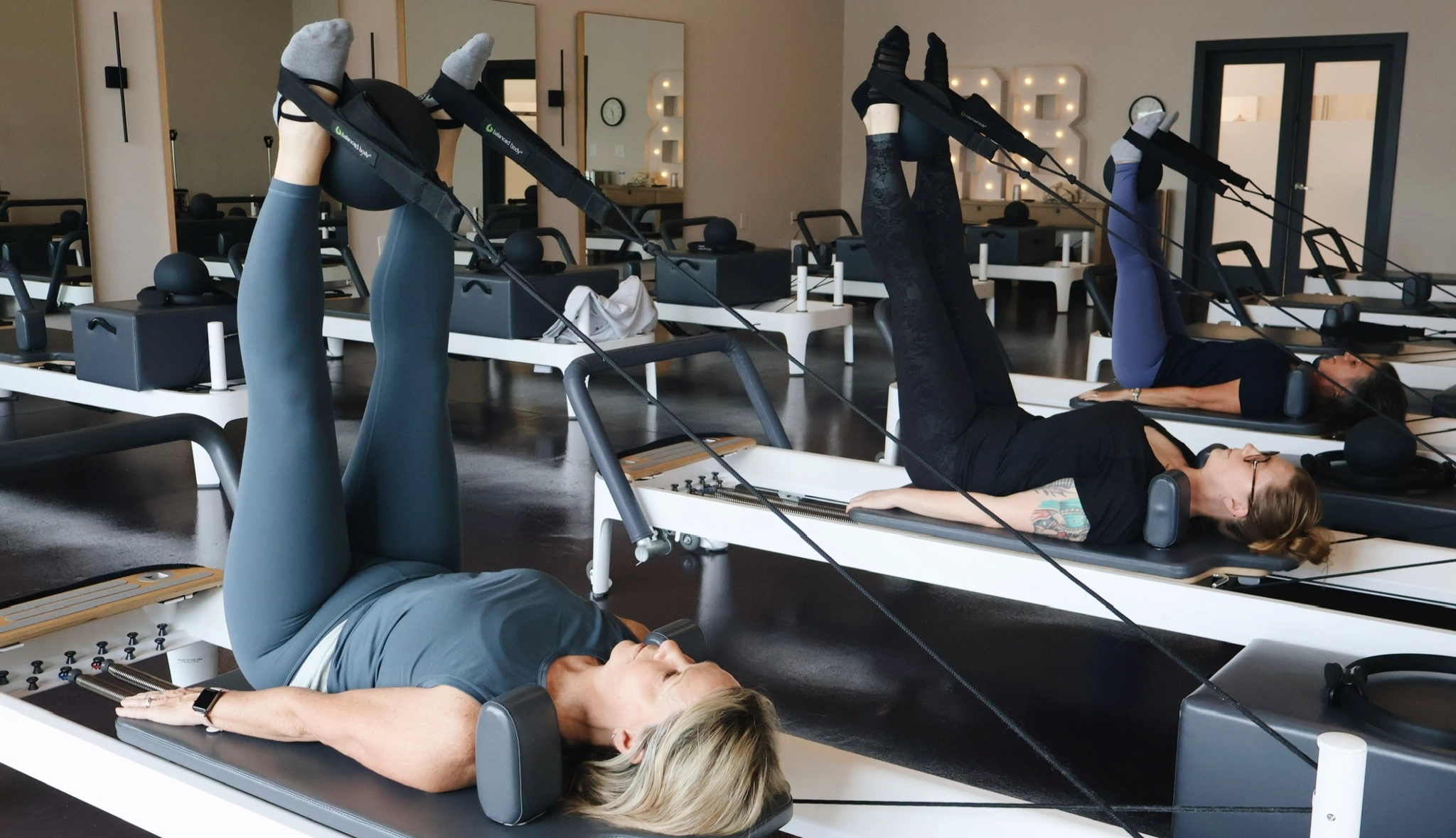
Pilates for Runners: Run Stronger and Stay Injury-Free
If you run, you have probably heard the same advice many times: strengthen your core, work on your hips, stretch more. The advice is sound. The problem is that most runners never act on it, or they add a few planks and foam rolling sessions that barely scratch the surface. Pilates for runners offers a more complete answer. It trains the stability, mobility, and body control that running demands but never builds on its own.
This is not about replacing your miles. It is about protecting them. Early research shows that runners who add Pilates to their training can run faster and more efficiently, and the method targets the same weak links that research connects to common running injuries.
Why Runners Get Hurt in Predictable Patterns
Running is a linear, repetitive, high-impact activity. Each stride loads your body with roughly two to three times your body weight, and a typical run includes thousands of those impacts. That repetition builds excellent cardiovascular fitness and strength for moving forward, but it does little for side-to-side stability or rotational control.
The result is a predictable set of injuries. A 2021 systematic review of running injury research found an average injury rate of about 40 percent. The most common problems include Achilles tendinopathy, shin splints, runner’s knee (patellofemoral pain), plantar fasciitis, and ankle sprains. The knee was the most commonly injured area, and about 79 percent of injuries happened at or below the knee.
What connects many of these injuries is not mileage alone. It is what happens further up the chain: weak hip stabilizers, underactive glutes, poor trunk control, and limited mobility through the hips and ankles. Over thousands of strides, the knees, shins, and feet absorb forces they were never meant to handle alone. As fatigue sets in, the trunk sways, the pelvis drops, and running form breaks down.
These are exactly the areas Pilates is designed to train.
What the Research Shows
Research on Pilates in runners is still a young field, but the results so far are promising, and they fit with a larger body of research on core training and running mechanics.
The most cited study is a 2018 randomized trial published in PLOS ONE. Trained male recreational runners were split into two groups. One group added mat Pilates (two one-hour sessions per week for 12 weeks) to their normal running, and the other group only ran. The Pilates group improved their 5K time by about 2 minutes and 25 seconds, compared with about 43 seconds for the running-only group. The Pilates group also used less energy at the same pace and showed lower activity in their postural muscles, including the obliques, back extensors, and gluteus medius. In simple terms, a more stable trunk wasted less energy holding posture, which left more energy for moving forward.
A 2019 study of male college athletes found that eight weeks of core training improved balance, core endurance, and running economy, with lower heart rate and oxygen use at the same running speeds. This study used general core exercises rather than Pilates, but the focus on trunk stability, balance, and control overlaps closely with the Pilates method.
A note on the evidence: both studies were small, included only men, and ran for a short time. No trial has yet tested whether Pilates directly reduces running injuries. What the research does show is that Pilates improves the stability and efficiency that injury research points to again and again.
How Pilates Addresses the Weak Links Running Exposes
Hip Stability and Glute Strength
Running is repeated single-leg loading. With every stride, one leg holds up the whole body while the other swings forward. The side hip muscles, especially the gluteus medius and the deep hip rotators, keep the pelvis level during that moment. When they are weak, the pelvis drops, the knee falls inward, and the IT band, kneecap, and ankle absorb the extra force. This pattern is linked to runner’s knee, IT band syndrome, and shin splints.
Pilates trains these muscles directly. The Reformer’s side-lying leg series, single-leg footwork, and hip-focused exercises isolate the side hip stabilizers in positions where runners cannot cheat with their usual movement habits. Spring resistance adds load step by step, without impact.
Core Control Beyond Crunches
When runners hear “core,” they often think of sit-ups. But the core strength that matters for running is deep stability: the transversus abdominis, multifidus, and pelvic floor muscles that keep the trunk steady against the twisting forces of every stride. The goal is not power. It is endurance, the ability to keep the trunk quiet and efficient over thousands of steps.
Pilates was built around this idea. Every Reformer exercise starts from a stable, controlled trunk, and the springs challenge that stability through changing loads and positions. The lower postural muscle activity seen in the 2018 study shows this effect: a trained core needs less effort to stay stable.
Hip Flexor and Hamstring Mobility
Runners are known for tight hip flexors, caused by both the running motion and the hours of sitting around most people’s training. Limited hip extension pushes extra movement into the lower back, which can contribute to the low back pain many runners feel. Our guide to exercises for lower back pain explains how Pilates helps there.
On the Reformer, springs support the stretch while you stay in control, so you can work through a fuller range of motion than with passive stretching alone. Hip flexor and hamstring work on the Reformer lets tight runners reach ranges they cannot reach on their own.
Ankle and Foot Strength
Reformer footwork trains the small muscles of the foot and the whole calf through full range of motion, from a deep ankle bend to a full point. This builds ankle stability and strengthens the push-off that runners rely on with every stride. For runners dealing with plantar fasciitis or shin splints, this kind of controlled, low-impact training can be especially useful.
Breathing
Pilates teaches lateral breathing, which means expanding the ribcage to the sides instead of breathing high into the chest. Some runners find that learning to match breath with movement helps them feel more in control at harder efforts. The evidence here is mostly based on experience rather than clinical trials, but it is a skill many running coaches also teach.
Why the Reformer Matters for Runners
The 2018 study used mat Pilates and still produced strong results, which shows the power of the method itself. The Reformer adds tools that are especially useful for runners.
Spring resistance trains muscles as they lengthen under control. This mirrors running, where the quads, glutes, and calves must absorb and control force every time your foot lands. The moving carriage also challenges balance and body awareness in ways that floor exercises cannot. Exercises can be done lying down, on your side, or kneeling, which isolates specific weaknesses without the habits runners fall into when standing.
For runners working through a specific injury or training for a goal race, Private Sessions at Right Balance Pilates open up the full set of Balanced Body apparatus. The Chair builds single-leg strength and balance that closely matches the demands of running. The Cadillac/Tower allows supported stretching and loaded hip work. The Barrel opens the upper back and the front of the hips. These tools target specific gaps with a level of precision that a group class may not reach.
How Much Pilates Does a Runner Need?
Two Pilates sessions per week alongside your running is a practical target, and it matches the schedule used in the 2018 study. A runner doing four runs and two Pilates sessions each week is often better positioned than one doing six runs and no cross-training.
The common objection is time. But Pilates can replace the stretching, foam rolling, and strength work you are probably supposed to be doing and probably skipping. Instead of piecing together a post-run routine, one Pilates session covers core stability, hip strength, flexibility, and body awareness in a single hour.
Timing matters too. Schedule Pilates on easy run days or rest days, not right before or after your hardest workouts. During base building, you can add more sessions for foundational strength. As race training gets more intense, drop back to one or two sessions focused on mobility and activation.
Getting Started: What Runners Should Expect
If you are new to Pilates, start with a Private Session or a Level 1 Reformer class. Arrive a few minutes early to meet your instructor and talk about your goals. Level 1 works well for athletic, body-aware runners, with exercises done lying down or seated. Private Sessions are the better choice if you have a very specific focus or are working through an injury.
An honest expectation: Level 1 will likely be humbling. Runners often overestimate their readiness because they are fit, but Pilates challenges the stabilizing muscles and mobility that running never develops. The exercises that feel hardest are showing you exactly where the gaps are. That is the point.
At Right Balance Pilates, several instructors understand running from personal experience. Tracy Vosler is a physical therapist with more than 30 years of orthopedic experience and a background in collegiate soccer and CrossFit. Valerie Mills has competed in triathlons and still runs, and Pilates has been part of her own training since 2005. When a runner arrives with IT band pain or tight hip flexors, these instructors do not have to guess what the sport demands.
The Delaware and Eastern Shore running community is strong, from Seashore Striders events to Rehoboth Beach Marathon weekend to the groups that log miles on the Cape Henlopen trails. Right Balance Pilates has studios in Lewes, Rehoboth Beach, Bethany Beach, Fenwick Island, and Middletown, Delaware, and Easton, Maryland, so adding Pilates does not have to mean adding a long drive to your training week.
Your Running Does Not Have to Hurt
The miles you love do not have to come with chronic pain. Many of the injuries that sideline runners year after year trace back to stability and mobility gaps that running cannot fix on its own. Pilates helps fill those gaps, steadily and without adding more pounding to a body that already absorbs plenty on the road.
Whether you are managing a nagging injury, training for a race, or building a running habit that lasts for decades, we would love to help you find the right balance between the miles and the method.
This article is for educational purposes and is not medical advice. If you have a running injury, talk with your doctor or physical therapist before starting a new program.
Sources and Further Reading
- Finatto P, et al. Pilates training improves 5-km run performance by changing metabolic cost and muscle activity in trained runners. PLOS ONE, 2018.
- Hung KC, et al. Effects of 8-week core training on core endurance and running economy. PLOS ONE, 2019.
- Kakouris N, et al. A systematic review of running-related musculoskeletal injuries in runners. Journal of Sport and Health Science, 2021.
GET STARTED
Sign Up Today With Right Balance Pilates