
Pilates for Osteoporosis: How It Supports Bone Health
If you have been diagnosed with osteoporosis or osteopenia, you have probably been told to do weight-bearing exercise. What you may not have been told is which exercises, how to do them safely, or what to avoid. That gap between diagnosis and action is where most people get stuck, and it often leads to moving less out of fear rather than moving better with guidance.
Pilates for osteoporosis is not a cure, and it does not replace your medical treatment plan. But research supports it as a valuable part of managing bone health. The 2022 UK consensus statement Strong, Steady and Straight, published in the British Journal of Sports Medicine, found little evidence that physical activity causes significant harm for people with osteoporosis and concluded that the benefits generally outweigh the risks. Where Pilates contributes most is not by reversing bone loss directly (the evidence there is limited and mixed) but through three pathways linked to lower fracture risk: better balance, stronger muscles around vulnerable bones, and improved posture.
Three Ways Pilates Protects Your Bones
Better Balance, Lower Fall Risk
Most hip and wrist fractures happen after a fall, which makes balance training just as important as bone loading. Pilates challenges balance through single-leg work, standing sequences, transitions between positions, and core stabilization on the moving Reformer carriage. Systematic reviews show that Pilates improves both static and dynamic balance in older adults. Research has not yet shown directly that Pilates reduces the number of falls, but poor balance is one of the strongest fall risk factors, and improving it is a central goal of any fall prevention plan. Our guide to Pilates for Seniors covers this evidence in more depth.
Stronger Muscles Around Fracture-Prone Areas
Pilates strengthens the hip muscles, spinal extensors, and shoulder girdle, the muscle groups around the spine, hips, and wrists where osteoporotic fractures most often occur. Stronger muscles absorb force and improve how load travels through the skeleton during everyday tasks like carrying groceries, bending down in the garden, or getting up from a chair.
The spinal extensors deserve special attention. In a Mayo Clinic study, postmenopausal women who completed two years of back-strengthening exercise still had stronger backs, higher bone density, and fewer vertebral compression fractures than a control group ten years later.
Better Posture, Less Stress on the Spine
Osteoporosis often leads to increased forward rounding of the upper back, called thoracic kyphosis. This shifts your center of gravity forward, adds compressive load on the front of the vertebrae, and raises the risk of both spinal fractures and falls. Pilates emphasizes spinal extension, lengthening through the spine, and postural awareness. The UK consensus statement names posture as one of its three core goals, alongside strength and balance. For more on how extension-based work supports the spine, see Exercises for Lower Back Pain: How Pilates Strengthens What Hurts.
Pilates for Osteoporosis: What to Modify and Why
This is where instructor expertise matters most. Clinical guidelines and osteoporosis-specific Pilates resources agree on one core principle: avoid or modify loaded forward spinal flexion, flexion combined with rotation, and rolling on a curved spine. The reason is simple. When the spine bends forward under load, compressive forces concentrate on the front of the vertebral bodies, which is exactly where osteoporotic bone is weakest.
In practice, this means exercises like the Roll Up, Rolling Like a Ball, the Saw, and deep abdominal curls are set aside or reworked. These changes do not gut the Pilates repertoire. They redirect it toward neutral-spine exercises, supported spinal extension, hip-hinge patterns, and isometric core work like planks and quadruped reaches. All of these are effective, challenging, and appropriate for bone health.
At Right Balance Pilates, instructors like Laura Reitman, an orthopedic physical therapist for 23 years, and Tracy Vosler, a physical therapist with more than 30 years of orthopedic experience, build these modifications into sessions for clients with bone health concerns. They understand the contraindications, the progressions, and the biomechanics, so clients never have to guess what is safe. The goal here is confidence, not fear. For a knowledgeable instructor, these modifications are routine, and Private Sessions make it possible to plan them in depth around your history and your goals.
Why Reformer Pilates Is Especially Well-Suited
The Reformer provides spring-based resistance that is adjustable, progressive, and low impact, the kind of controlled loading that muscles and bones respond to. Exercises can be done lying down, seated, or standing with support, giving instructors options for every comfort level. Footwork and lunges load the hips and legs, pulling straps and chest expansion work the upper back and shoulders, and the moving carriage challenges balance in a supported setting.
Spring resistance scales in small steps. A client in their first week works with full support on light springs, and months later can progress to heavier resistance and more complex patterns. Private Sessions at Right Balance Pilates can also go beyond the Reformer with the Cadillac/Tower for supported spinal extension, the Chair for standing balance work, and the Barrel for extension-based back strengthening. This range of Balanced Body apparatus lets an instructor tailor a program to each client’s bone health needs.
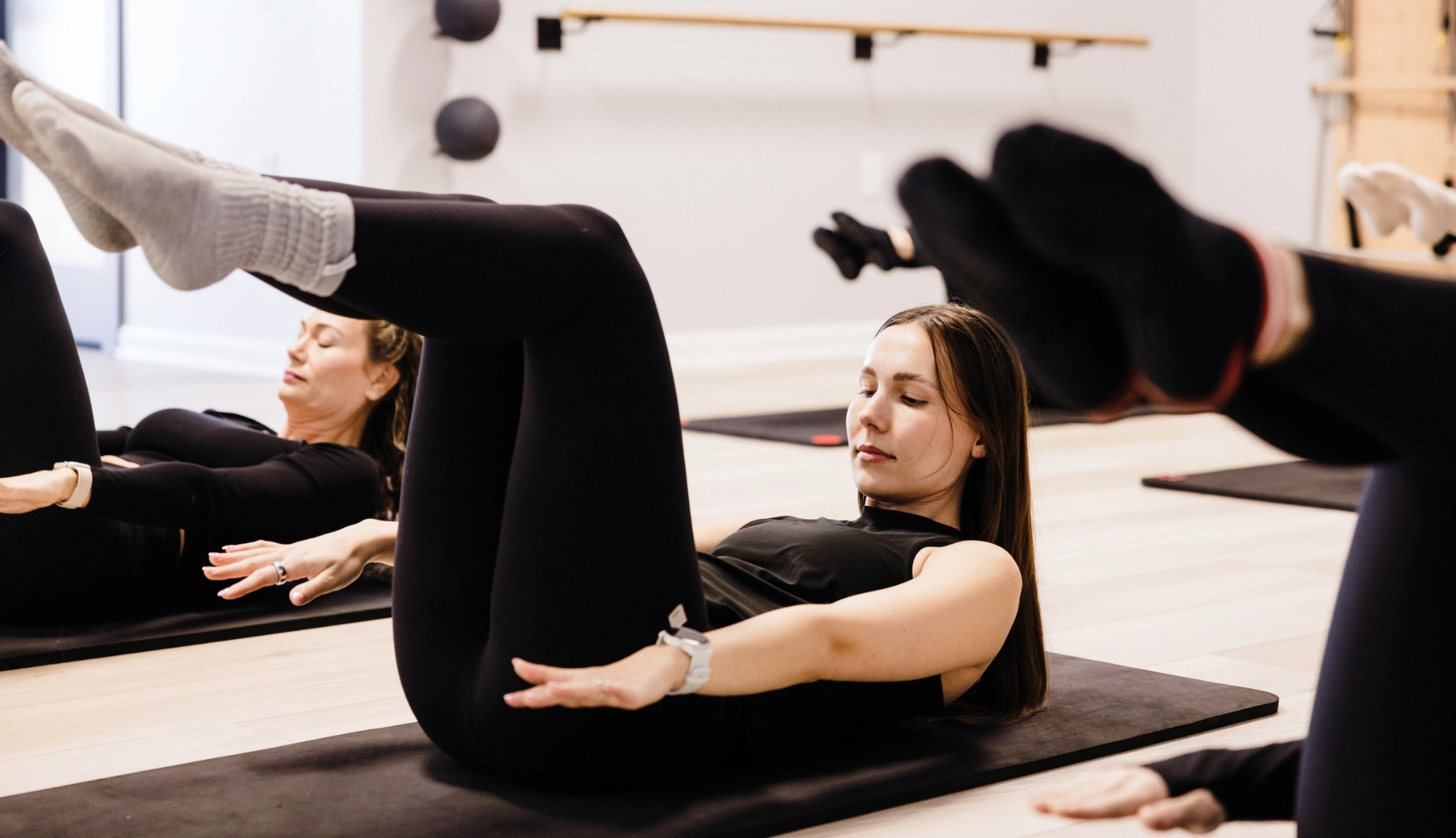
Mat Pilates builds the same foundations using body weight and small props. Many classic mat exercises involve rolling or forward curling, so tell your instructor about your diagnosis before class. They will offer neutral-spine alternatives so you can take part with confidence.
Common Questions About Pilates and Bone Health
Is Pilates safe if I have osteoporosis?
For most people, yes, when exercises are chosen and modified appropriately. The main precaution is avoiding loaded forward bending and twisting of the spine. For people who have had a vertebral fracture or several low-trauma fractures, the UK consensus statement recommends specialist guidance and keeping impact to about the level of brisk walking.
Can Pilates increase bone density?
Research on Pilates alone increasing bone density is limited and mixed. Its clearest benefits are strength, balance, and posture, which are all linked to lower fracture risk. Many people pair Pilates with other activity their doctor recommends, such as walking or strength training.
Do I need my doctor’s approval first?
It is always a good idea to talk with your doctor or physical therapist before starting a new exercise program, especially after a recent fracture. Share any guidance they give you with your instructor so your sessions reflect it.
Where to Start
If you have been diagnosed with osteoporosis or osteopenia, we recommend starting with a Private Session. Your instructor will review your health history, talk through any concerns, and build a modification plan around the movements that work best for your body. Once you feel confident with that plan, our Basic and Level 1 group Reformer classes are a natural next step. Level 1 keeps you in supported positions, lying down or seated, with no standing, kneeling, balance challenges, or inversions.
New to Pilates entirely? Our Pilates for Beginners guide covers what to expect, and our Get Started page walks you through setting up your account and booking an intro.
Right Balance Pilates has studios in Lewes, Rehoboth Beach, Bethany Beach, Fenwick Island, and Middletown, Delaware, and Easton, Maryland, with instructors whose backgrounds include physical therapy and nursing. Osteoporosis does not have to mean a life of caution. With the right guidance, it means intentional movement that protects your bones and keeps you doing what you love.
This article is for educational purposes and is not medical advice. Please talk with your doctor before starting a new exercise program.
Sources and Further Reading
- Brooke-Wavell K, et al. Strong, Steady and Straight: UK consensus statement on physical activity and exercise for osteoporosis. British Journal of Sports Medicine, 2022.
- Sinaki M, et al. Stronger back muscles reduce the incidence of vertebral fractures: a prospective 10 year follow-up of postmenopausal women. Bone, 2002.
- The Effectiveness of Pilates Training Interventions on Older Adults’ Balance: A Systematic Review and Meta-Analysis of Randomized Controlled Trials. 2023.
- Effects of Pilates exercises on postural balance and reduced risk of falls in older adults: A systematic review and meta-analysis. Complementary Therapies in Clinical Practice, 2024.
GET STARTED
Sign Up Today With Right Balance Pilates