
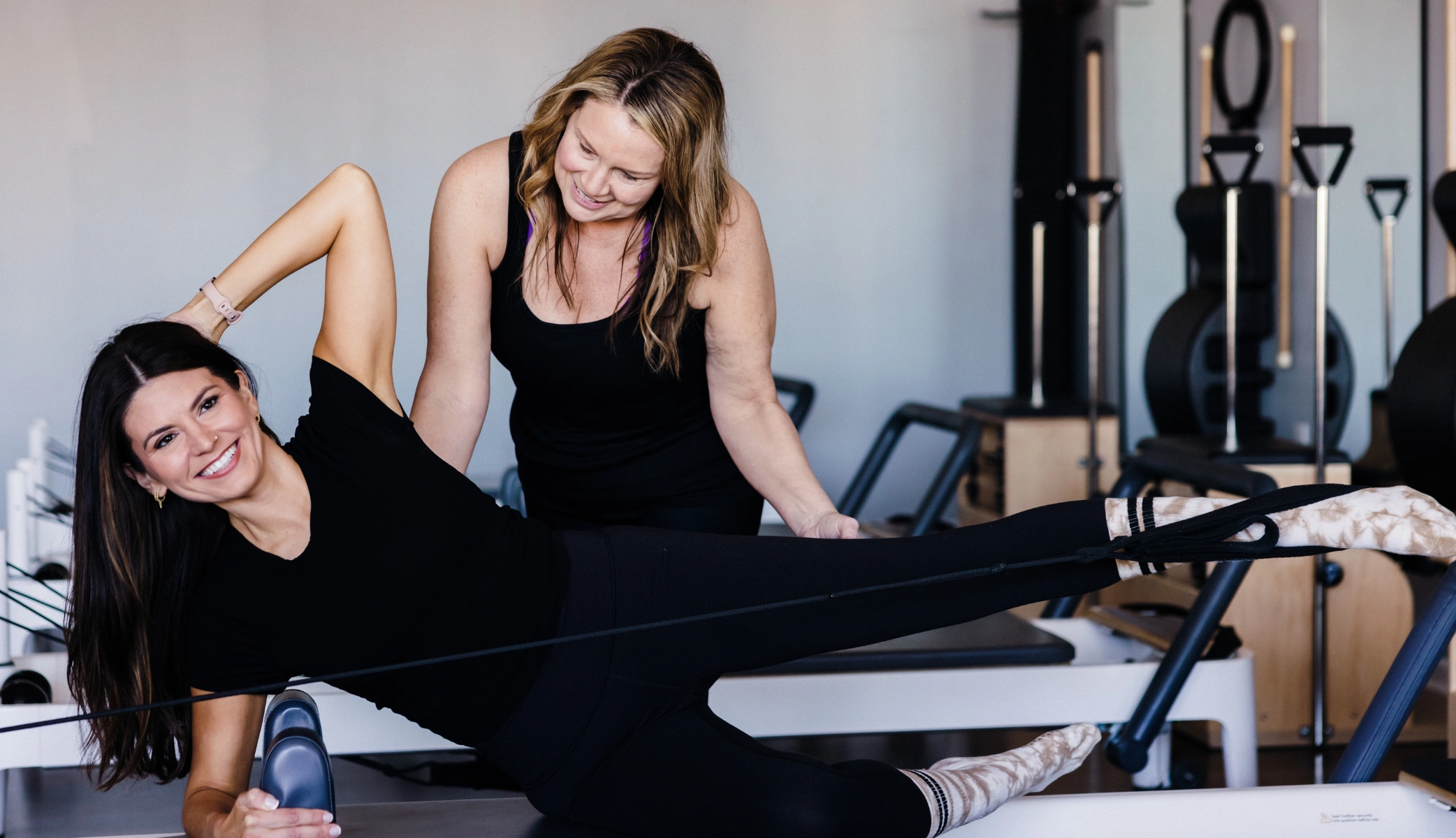
What Is Reformer Pilates? A Complete Guide
Reformer Pilates is one of the most popular forms of exercise in the country, and for good reason. You have probably heard the word “reformer” and wondered what it actually means. Maybe a friend swears by it, or your physical therapist suggested you try it. Either way, the reformer can sound intimidating before you have seen one in person.
The good news: it is far more approachable than it looks. This guide covers what a Pilates reformer actually is, how a session works, who it is best suited for, and how reformer Pilates compares to mat work. If you are considering your first session, this is the place to start.
What Is Reformer Pilates and How Does It Work?
A Pilates reformer is a bed-like frame with a sliding carriage, a set of adjustable springs, a footbar, shoulder blocks, and straps connected to pulleys. You lie, sit, kneel, or stand on the carriage and push or pull against the springs, which provide resistance that increases as they stretch. Unlike a dumbbell or weight stack, where the load stays constant, spring resistance builds through the range of motion, demanding more control precisely where it matters most.
By changing which springs are attached, where your body is positioned on the carriage, and the direction of force, your instructor can fine-tune every exercise. The same movement can target the core, the hips, or the shoulders depending on the setup. That adjustability is what makes reformer Pilates so effective for such a wide range of people, from someone recovering from a knee replacement to an athlete refining their movement patterns.
The machine also provides instant feedback. If the carriage drifts, bangs, or twists, that is information about your alignment and control. The straps, footbar, and shoulder blocks act as built-in reference points, helping you feel when your body is working symmetrically and when something is off.
The apparatus traces back to Joseph Pilates, who developed his method (originally called “Contrology”) in the early 20th century. He experimented with attaching springs to hospital beds to help injured soldiers rehabilitate, then refined the concept into a dedicated machine he called the Universal Reformer. His idea was that clients would “reform” their bodies on the apparatus, building enough alignment and strength to eventually perform mat work and daily movement more effectively. Modern reformers have evolved in form, but the core concept has not changed: a spring-loaded sliding carriage that trains strength, alignment, and coordinated movement across the whole body.
What a Reformer Pilates Session Actually Feels Like
If you have never tried reformer Pilates, here is what to expect. The first thing most people notice is how different it feels from any other workout. The carriage glides beneath you, and the springs create a resistance that is smooth and progressive rather than jarring. You are working hard, but the machine is working with you.
A typical session flows through a sequence of movements that engage the entire body. You will usually begin lying on your back for footwork at the footbar, pressing the carriage open and closed with your feet. This warms up the legs and hips while teaching you how the springs feel and how to control the carriage. From there, the session might move into bridging and spinal articulation, arm and leg work using the straps, seated or kneeling exercises for posture and upper body strength, and plank variations for integrated core and shoulder stability.
Beginners typically work with lighter springs and spend most of the session in supported positions, like lying on the back or sitting. The emphasis is on orientation, breath, and control rather than intensity. You will not be gasping or grinding through reps. The challenge is more internal: learning to engage the right muscles, finding smooth control through the full range of motion, and noticing where your body compensates. Most people leave their first session surprised by how much they felt it the next day, despite nothing having felt extreme in the moment.
As you progress, classes incorporate more challenging positions such as kneeling or standing on the moving carriage, higher spring loads, and multi-directional movements that build power, balance, and reaction time.
At Right Balance Pilates, the group class leveling system reflects this progression. Basic Reformer classes introduce the principles, terminology, and simple movement patterns with ample rest and instruction. Level 1 builds on that foundation with exercises in supported positions. Level 1.5 introduces balance challenges like kneeling and standing on the carriage with clear progressions. Level 2 classes are fully intermediate, incorporating advanced sequences, reduced rest, and faster pacing. Every level includes modifications, so the experience meets you where you are.
Who Benefits Most from Reformer Pilates
Because the reformer is low impact and highly adjustable, it serves a remarkably wide range of people.
People Dealing with Pain or Recovering from Injury
The springs can be set to support the body while gradually building core and hip strength. A 2025 randomized controlled trial published in BMC Psychology found that a six-week reformer program for people with chronic musculoskeletal pain significantly reduced pain intensity, improved pain-coping strategies, and improved sleep quality compared to a non-exercise control group. Another study published in the Turkish Journal of Kinesiology reported that an eight-week beginner-level reformer program led to meaningful improvements in functional disability scores for women with non-specific lower back pain.
At Right Balance Pilates, several instructors bring clinical backgrounds to their teaching. Laura Reitman practiced as an orthopedic physical therapist for 23 years and integrates Pilates into blended wellness plans for clients seeking core stabilization. Tracy Vosler is a physical therapist with over 30 years of orthopedic experience. Eileen Kane holds a Master’s degree in Physical Therapy and pursued additional certification in hand and upper quarter rehabilitation. Martha Worthington and Kimberly Deloy bring decades of nursing experience. These credentials mean that modifications for injuries, post-surgical recovery, and chronic conditions are standard practice in classes, not an afterthought.
Active Adults and Athletes Looking for an Edge
A randomized controlled study on amateur soccer players found that both mat and reformer groups improved physical performance, but the reformer group saw stronger gains in certain metrics, likely due to the machine’s greater mechanical resistance and functional variability. Reformer Pilates builds the kind of deep, connected strength that carries over into running, golf, tennis, cycling, and virtually any sport that demands rotational control, hip mobility, or balanced power.
People Who Find Mat Exercises Too Challenging
Movements like roll-ups and teasers can be genuinely difficult to perform with good form using only body weight. The reformer’s springs and carriage can assist your body into those positions while you build strength and coordination. The machine does not make things “easy.” It makes them accessible, which is a meaningful difference.
Anyone Building Long-Term Strength and Mobility
A 2025 study published in Scientific Reports found that an eight-week reformer program (three sessions per week) led to significant improvements in body composition, muscle strength, endurance, and reductions in depression and anxiety. The Cleveland Clinic describes Pilates as both therapeutic and preventive, helping people recover from existing issues while establishing a baseline of function that makes future recovery faster.
Reformer vs. Mat Pilates: How They Compare
Both reformer and mat Pilates share the same core principles: centering, control, precision, breath, and flow. The difference is in how they load the body and provide feedback.
Mat Pilates uses body weight and gravity alone. That simplicity is a strength. Mat work is accessible anywhere, requires no equipment, and can be a very demanding form of training. Some mat exercises are actually harder than their reformer equivalents, because there is no spring assistance and no carriage to guide alignment.
Reformer Pilates adds adjustable spring resistance and a moving surface. The springs can either assist you (making difficult movements achievable) or increase the load (making familiar movements more challenging). The carriage also provides larger, more guided ranges of motion, especially for the hips and spine, and gives clear tactile feedback about symmetry and control.
Medical sources note that reformer Pilates tends to produce stronger gains in agility, dynamic balance, and targeted strength, while mat work is particularly effective for building body-weight control and can be practiced at home without studio access.
The two are not competing options. In many well-designed programs, the reformer builds alignment and strength that carries over to mat work and daily life. At Right Balance Pilates, both group reformer and mat classes are offered, and private sessions go further, drawing on all five pieces of Pilates apparatus: the Reformer, Cadillac/Tower, Chair, Barrel, and Mat. Each piece solves different movement problems. The reformer handles alignment and load, the Cadillac provides support and traction, the Chair develops vertical control, and the Mat builds self-sufficiency. That comprehensive approach is what separates a full Pilates studio from a reformer-only operation.
How Often to Practice and When to Expect Results
Most research on reformer Pilates shows meaningful improvements with two to three sessions per week. The studies cited above used six- to eight-week programs and found measurable changes in strength, pain levels, mobility, and body composition within that window. That lines up with what instructors see in practice: clients who commit to a consistent schedule typically notice real differences in how they feel and move within their first two months.
That said, even one session per week can maintain progress and reinforce the movement patterns you are building. The most important factor is consistency, not intensity.
A Note on Safety and Instruction Quality
Reformer Pilates is generally safe and low impact, but it is not risk-free. The Cleveland Clinic notes that poor supervision, excessive resistance, or exercises that are not appropriate for someone’s condition can lead to strain, particularly in the spine, shoulders, and knees. The Pilates Foundation, a UK-based professional body, has specifically warned that reformer classes can be problematic when taught by instructors with inadequate training, because the springs and moving carriage can magnify existing movement faults rather than correct them.
This is why instructor qualifications matter. Right Balance Pilates is Delaware’s only state-licensed Pilates education center, with over 30 years of combined teaching and training experience on staff. Every instructor is trained and can provide modifications for injuries as part of every class. For people with specific conditions, such as osteoporosis, disc issues, or post-surgical restrictions, private sessions allow a qualified instructor to tailor the apparatus, springs, and movement selection to exactly what the body needs.
Getting Started
If you have been curious about reformer Pilates, the best next step is to experience it firsthand. An introductory session covers the basics of the machine, walks you through a form-focused workout, and gives you a clear sense of what to expect in group classes. It is low-pressure, supportive, and designed for people who are brand new.
Right Balance Pilates offers complimentary group intro sessions at studios across Lewes, Rehoboth Beach, Bethany Beach, Fenwick Island, and Easton, Maryland, with two new locations opening in Middletown and Milford in summer 2026. Private intro sessions are also available for a more personalized experience. We welcome all ages and experience levels, and our instructors are here to help you find the right starting point for your body, your goals, and your comfort level.
Book a Free Intro Session | View the Class Schedule | Learn About Private Sessions
Sources and Further Reading
- Pilates Method Alliance (PMA)
- Balanced Body Education
- Cleveland Clinic, “Pilates 101: What It Is and Health Benefits”
- Pilates Foundation, “Are Reformer Classes Safe?”
- Sahan, N. et al. (2025). “Effects of reformer Pilates on pain, psychological factors, and sleep in chronic musculoskeletal pain.” BMC Psychology, 13:836.
- Gokalp, O. & Kirmizigil, B. (2025). “Effects of reformer Pilates on body composition, strength, and psychosomatic factors.” Scientific Reports, 15:23602.
GET STARTED
Sign Up Today With Right Balance Pilates